Ditch the matchsticks. Get some sleep.

I love my sleep. I mean I really love my sleep. This isn’t even the first time I’ve blogged about it. The only problem is that I’m not very good at it.

Once, when on an expedition trip to Borneo as a wide-eyed fifteen year old, I was told off by our tour leader for falling asleep on a bus ride through a city – “You’re missing out on all the sights!”. I turned my head and went right on sleeping. We’d been in the jungle for a week, ‘sleeping’ on hideously uncomfortable canvass hammocks and hiking for miles every day. I was exhausted.

Sure, I probably missed a couple of spectacular buildings and some exotic goods being touted on street-side market stalls, but frankly I’m not one of those people who subscribes to the idea that “you can sleep when your dead”. Rather, if I’m operating in a sleep deprived state, I feel dead. I can’t concentrate. I feel unwell. I can’t function. And that just won’t do.

We all know that a lack of sleep is bad for us – at best we end up grouchy and at worst a regular lack of sleep can lead to heightened risk of serious medical conditions such as heart disease and diabetes – so how can we make sure that we’re getting more of this precious luxury?

Our friends at Casper have sent us simple but effective tips and set us the challenge of pledging to make a change to our bedtime habits for a month to see how much of a difference it makes. Casper knows first hand that a lot goes into your sleep and your sleep routine but something as simple as heading to bed 30 mins early or even looking into a new bed, can drastically benefit your nights rest (and wellbeing)!

This slideshow requires JavaScript.

For me the problem is no longer the discomfort of rainforest sleeping arrangements, but rather having a lot of thoughts buzzing around in my head, so I am pledging to put my phone down an hour before going to sleep and reading, rather than looking at a screen, before bed.

We’d love to hear any more tips you guys have for getting a good night sleep too – leave us comment below.

Good night!

10 things j’adore about Le Tour

It’s every cyclist’s (and wannabee’s) favourite 3 weeks of the year again…Le Tour is back in full swing and we are all trying our best to be in the breakaway group on London’s cycle superhighways and wondering why the person on a Boris bike (sorry, Santander cycle) behind you isn’t responding to when you flick your elbow to get them to take the lead (just me then?)

Today is the first rest day (and by rest day, I mean they will just go out and do a casual 1-2 hour ride rather than say, 5 or 6 hours) and we have already have TONNES of drama. From Cavendish becoming the 2nd highest stage winner of all time, to Steve Cumming’s second solo breakaway win in as many years (WHY is he not in the Olympic team?), to Froome’s mental descending technique (that did the job) and the loss of Contador yesterday, it’s been a rollercoaster thus far. THREE BRITS IN JERSEYS!

So, without much further ado, here are some reasons why I love it…

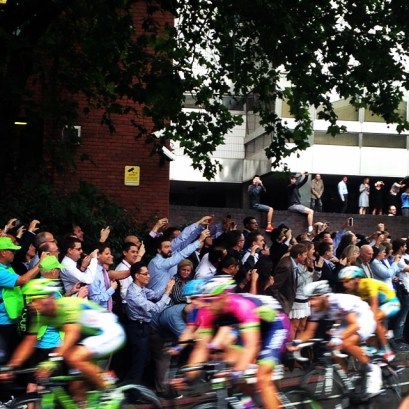
  1. How easy it is to go and watch! I’ve been brought up taking little excursions to random locations in France where you can literally turn up at the side of the road and see them all go past…which is a brilliant (and free) introduction to cycling as you can just sense the speed. Obviously, the more popular locations such as the big climbs such as Alpe D’Huez have people turning up days in advance, but if you know there is a stage near you, you can pretty much always find somewhere to watch it. Key tip – take a radio or stand next to someone who has one to keep up with what is happening.

Tour De France London 2014

  1. The commentary. Watching it live is often up there with TMS in that commentators like to go a bit off topic…chateaus being top of the list of distractions. The ITV commentary team has changed up a bit though, which means probably less chateaus but more actual insight into what the peloton is going to do (thanks David Millar)
  1. The cliches. Seriously, if you pay attention to the Tour for any period of time, you quickly learn which rider does what, and key commentary terms to describe them. You can then start doing impressions (Chris Froome looking at stems is probably one of my favourite Tumblrs) and talking knowledgeably about Contador ‘dancing on the pedals’.
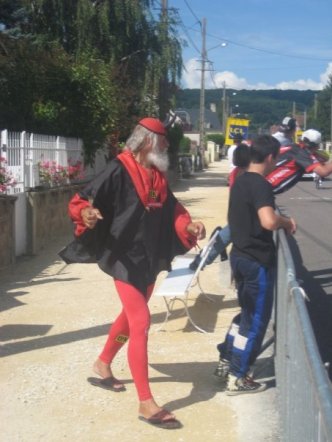
  1. The characters. I’m not just talking about the riders, but the people who come to watch. In particular, the man below. Didi is a long term fan favourite at both the Tour and the Giro d’Italia since 1993 and even has his own Wikipedia page. 

Didi the Devil Tour de France

  1. The welcome from any town/village/hamlet/field that the riders pass through. There have been some amazing spectacles at the side of the road and artwork in fields. “Tour de France field art” is a legit Google search term.
  1. The DRAMA! See my point above. People fall off, favourites give up, people attack when others have mechanicals, it rains, it hails, it’s sunny, there are cobbles, spectators get punched in the face, people do drugs, people cycle across fields, people crash into telegraph poles and break their favourite sunglasses…this happens
  1. The speed of technical changes. If, whenever I got a puncture, someone could just get me a new wheel and change it in 10 seconds, it would be great. I tried to put a wheel back on without turning the bike upside down the other day and it was the most frustrating thing in the world! (I add to this that I would really like a support car to follow me on any bike ride from now on because it would save me a whooooole lot of trouble)
  1. The ability of the riders to ride on through pretty much anything. There are some hard crashes in the Tour. There is a lot of skin lost. Yet people manage to get back up, continue on and have their wounds cleaned by a doctor hanging out of the team car WHILST STILL CYCLING. Take that footballers. People GET THROWN INTO BARBED WIRE BECAUSE OF BAD DRIVING.
  1. The speed and distance. The speed is something you truly appreciate when you see it in person, because on TV they actually look kind of casual. I did Mt Ventoux a few years ago and it was absolutely exhausting and I only did the 21km climb…they are starting in Montpellier and finishing at the top of Ventoux, a total of 185km. Mental. They probably won’t stop for chips and sweets at the top either. Imagine averaging 30mph whilst being within an elbow distance of over a hundred people…or hitting 122kph on a downhill…actually, is that even possible?
  1. My final reason for loving the Tour is how much my family love it…This is what we have done (list non exhaustive…)
  • Made Top Trumps cards (the categories were dubious, as were the answers, but the pictures were great and we should probably trademark them)
  • Nicknamed a lot of riders
  • Had the ITV coverage theme song as ring tones
  • Sung the theme song multiple times
  • Made up our own TdF song
  • Done impressions of the majority of cyclists whilst riding
  • Held intermediate sprints in the middle of our rides
  • Played TdF drinking games
  • Got upset when we’ve seen the result before the highlights show
  • Been to watch it in numerous places
  • Caught water bottles from riders
  • Read literally every cycling autobiography
  • Seen the caravane on the autoroute going the opposite way around France
  • Cycled the wrong way around a XC MTB trail to get caught in torrential rain, hide in a cow shed and give up trying to get to our viewing location and stop to eat chips instead…
  • …to then go and watch the time trial the next day

So, closet cycling fans….what do you love about it? Any weird TdF traditions in your family?

Open Water Swimming for Beginners – Hints & Tips

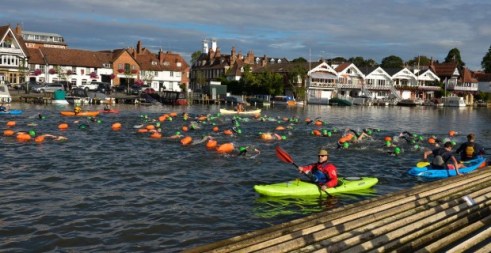
As I have previously testified, swimming is not one of my favourite activities, HOWEVER, sensible me decided giving into peer pressure at work to take part in the Henley Swim Club to Pub in July was a good idea.

Which meant one thing…I had to get back in the water. For me, swimming in a pool is a bit like running on a treadmill – boredom factor 100. Plus, the event is in the Thames, which is not a pool…therefore, I should not do all my training in the pool. Go figure.

Initial reservations about open water swimming often include “it’s not that easy to get to”, “it’s more difficult” and “it’s less safe than a pool”…and I can imagine “open water swimming for beginners” is a heavily Googled term! So, this post is here to quash some of those fears and streamline your introduction – it was written with the help of Henley Swim who have years of experience in this sort of thing, unlike my relative newbiness.

  1. Find a good location for your ability

There are a large number of lakes that run managed open water swimming sessions. These are safe places to start your open water career, and learn the basic skills, before becoming more adventurous and heading off into the rivers and sea. This list on 220 seems fairly up to date, but lakes have a tendency to open and close (!) so make sure you check the website before turning up.

IMG_2221.JPG

Shepperton (above) is convenient if you are in SW London but it is also often very busy and can be full of people who seem very fast – but one of best things about OW is how friendly and willing to help people are. The majority of reputable lakes will give a full safety briefing before allowing you to swim, as well as making you do a small demonstration that you won’t drown (typically a short swim, plus that you are able to perform the safety signal.

It’s often better to find somewhere that is fully focused on swimming (rather than also offering wakeboarding etc), simply because it means there are less obstacles (e.g. buoys) to worry about when you are on your swim, and you’re more likely to get dedicated attention. If you can’t get to a lake, you could always start with a lido – Tooting Bec (one of my despised locations) is 90m long. So it’s practically the same as being in a lake (feels like it anyway) but you don’t have to go as far.

NB Make sure you take into account whether they have cake. I would highly recommend the Victoria sponge at Trifarm.

  1. Never open water swim alone

This applies to both lake swimming (i.e. go during supervised sessions and flag if you are new/less confident) as well as when you are braving it in the more wild locations. There are a number of elements outside your control. Even the most experienced of swimmers can get into trouble, and being on your own can quickly make a bad situation worse.

These days there a large number of open water clubs springing up who can help new open water swimmers and offer coaching sessions which will help you build both your confidence and technique. Most lakes will link to sessions they hold on their websites or social accounts.

  1. Prepare for your open water swim – before and after

Standard kit would include wetsuit, goggles, high visibility swim hat, flip flops, towel, changing mat, and (waterproof!) watch.

After your swim the important thing is to get dry and warm as quickly as possible. A good post swim routine is key, for example: 1 – wetsuit off (and rinse it), 2 – flip flops on, 3 – get dry, 4 – layers on (hats are very welcome early in the season), 5 – hot drink. All fairly self-explanatory, but it’s amazing how many people get it wrong. If you have driven to your swim; get the heating on full blast on your feet (lovely!!)

As mentioned previously, also look for cake (but make sure you wash your hands…) Coke is good for killing pond bugs (true fact – that I don’t have a reference for) and bin-bags are handy to pop your wetsuit in until you can actually dry it out, just don’t leave it in there to go mouldy…Also, embrace pond hair. Gives it nice waves.

  1. Be ready for the temperature

Often, the biggest barrier is the temperature. It’s colder, pure and simple! Most swimming pools have a temperature of between 27-31 degrees centigrade. The warmest water you could hope to swim in (in the UK) would be about 20 degrees, so there is a big difference. When you first experience cold water your body will have a mild shock response and you will gasp. Gradually your body will adapt and you will become more comfortable – but it’s therefore advisable not to start your open water career in March. Most lakes will post the temperature on their website; 15 degrees is generally a good starting point.

Specially designed swimming wetsuits are readily available and not only keep you warm but also afford swimmers greater buoyancy, allowing you to achieve a better position in the water and have a faster and more comfortable swim.

You don’t need to buy a wetsuit to get started – most places allow you to hire them for a fee. Obviously, if you get into it, that fee per session generally warrants buying your own, but it isn’t a necessity. The best thing about wetsuits is the buoyancy – I’m wondering if I can use this as a technique to float 1100m downstream (although I might not finish within the hour unless the Severn Bore transplants itself to the Thames at that specific time)

IMG_8743

Spot Katie (I am the green hat on the left…trying not to drown)

  1. Remember that a lake is not a pool

There are no sides to push off, no steps to get in (well, in most cases!) and you can’t always feel the bottom. Or see it. Or see anything.

Go in prepared for this – don’t suddenly act surprised that a lake is murky. Some lakes will flag themselves as ‘not having weeds’, which is often something people don’t like, but rest assured, there isn’t much in a lake in the UK that you really need to be afraid of – it’s not Florida! Man up and get in! Supervised lakes will have a lifeguard and/or rescue boat (often a kayak), so you won’t be totally left to your own devices, but this is why it’s key to learn the safety sign. And practice treading water; often, the panic is quickly alleviated with some deep breaths. But this is why you should swim with others and not over-estimate your ability, which moves nicely on to…

  1. Don’t push yourself too early

Always have a plan of what you will be doing, and make sure that it is safe and within your capabilities. Getting tired, cold and cramping are not pleasant if you still have a long swim back to safety.  Most lakes will have both short (200-400m) and long (750+) loops to cater for all, so you don’t have to push further than you are willing – no-one else is counting how far or how long you swim for!

  1. Practise sighting

One of the (if not the) most important skills in open water swimming is sighting (seeing where you are going). Forgetting to regularly check and correct your course can add considerable distance to your swim. This is isn’t just a racing issue, where athletes need to swim the shortest possible distance, but also a safety issue, as it is important to ensure you know where you are and that you are swimming in a safe section of water. A good rule of thumb is to sight your course every 8 strokes. Poor visibility in the lake is also a common initial fear – but rest assured, you aren’t going to come across anything in a lake in the UK that will cause you that much fear.

(NB Sighting is equally important for staying on course and not crashing into buoys as it is for avoiding swans and ducks. Watch out – you have been warned!)

Be aware of who you are sharing the water with if you choose to swim outside supervised lakes (rowers and swimmers do not mix well) Joining a club or contacting the environment agency is a good place to start.

4d99e9ef-849e-4302-ac6c-ea01d81327e5-620x320

  1. Relax and enjoy it!

For the first few sessions you will probably be quite tense; for this reason try and keep these sessions short (or even get out and get back in again, a few times). Once you are in, focus on getting a good breathing cycle going. Generally if your breathing is working well, your body will relax.

One of my favourite things about being in the lake is having the sun scatter through the water – or the feeling of being rained on whilst being wet already, such is the weather. For me, it’s like trail running – I can totally tune out and enjoy being outside rather than focusing on hitting times and distances and proving something to myself. Also, you don’t smell of chlorine afterwards…just…nature.

If you’re keen to get involved in an open water event without having to cycle and run afterwards, then Henley Swim offer a multitude of distances, as well as having many resources available like these training plans to help you prepare. (I should probably now start actually preparing as opposed to ‘making up swim sets each time I go’)

And with that, I’m off to don my new goggles and hope they don’t leak!

bbeadb28-44c5-4b0f-a0e7-d1143df48e72-1


What I learnt playing rugby for the SECOND time

As some of you will know, last year I ventured out of the safety of touch rugby and into 7s, taking a trip down to Brighton with some of the girls from work for our FIRST EVER WORK FEMALE RUGBY TEAM (yeap, we are all over gender equality) and you know what, it wasn’t that bad, I didn’t break any bones and I think I kind of enjoyed it. It was sunny, there was beer and I learnt a lot of things – which you can read about here

Well, moving on a year, I’m no longer in the same job, but because I am therefore ‘alumni’, I am allowed to come back and play (plus, there still aren’t really quite enough girls…so I sort of had to)…but this year we kept it closer to home, opting for Summer Social in Richmond instead, which has grown from being a rugby festival to a ‘loads and loads of different sports’ festival. Kate O’C was gutted she couldn’t make it. So I will try not to rub in how much fun it was.
As Summer Social is of a pretty decent size (and because it started as a rugby tournament), there are several levels catering for all – Elite (men’s) , Open, Social and Ultra Social (men’s and women’s). Not entirely sure why the Women’s Open wasn’t just classed as elite, considering it included Scotland, Wales and a GB side…but oh well. On the plus side, this means that for a novice women’s team, you aren’t lumped against people who have been playing for years, which is the case for some tournaments where you can only get enough for one level (or so you think anyway)

Winding back a few hours…an early start was had as we had been at a rugby club ball the night before – surprisingly, my boyfriend choosing not to drink because he had to drive me to a 7s tournament the next morning. I however, did drink, despite having a 7s tournament the next morning. And moving swiftly on…

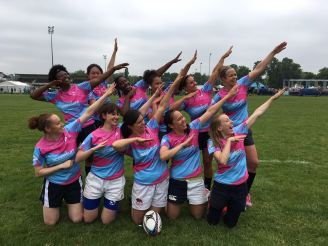
We arrived at Richmond, parked up and waited for the girls and SHINY NEW KIT! This was fairly exciting considering last year we just used our touch kit, which isn’t actually ideal for contact. Also, an extra gem – it matched my boots!

IMG_2171

Our first game was against Windsor. We lost.But we went in with not much structure or plan, hoping to use it as a warm up and then talk tactics afterwards. Which we kind of did. It was a learning curve – I remembered that tackling isn’t that difficult and falling over doesn’t hurt that much. And that it’s hard to talk with a gumshield!

The problem with there being so many games and general popularity of the tournament (men’s elite, open and the three women’s tournaments are at Richmond Athletic Ground, with men’s social being at Old Deer Park) means that there is a bit of waiting around between games – especially if the opposition never turns up. So our next game (Kingston) wasn’t for a good 3 hours! We took the time out here to indulge in healthy intra-game snacks (chips, pizza and the like) and actually run through some moves, covering the breakdown, defending as a line and a couple of set pieces.

Our next game was against Kingston rugby club and our practice showed! I don’t know what the score was…but we won! Boyfriend was also at this point promoted to subs manager, which took a layer of pressure off us from trying to think about playing and subbing.

Our third game was against the Pink Rinses (one of the well-known Pink Ba-Bas team, who are regularly on the 7s circuit) These women knew their rugby. Discovered afterwards that there were several ladies with MULTIPLE national caps in there, which explains a lot. This game was less ultra social and more stressful. I mean we lost by a chunk, but we played a cracking game considering their level of experience (lots) against ours (not quite as much) – and their coach said we stuck up for ourselves well.

IMG_2178

We finished up against Roehampton Uni, which was a nailbiter, finishing 26-22. Unfortunately to them. But it was a cracker, we won scrums (probably why my neck hurts so much) and everyone really put their all into it.

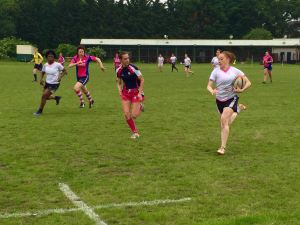
There is so much offside in this it's unbelievable

There is so much offside in this it’s unbelievable

So then a quick shower and onto the evening! Because we didn’t finish until far gone 6, it was clear the other sports had been at the bar for a good few hours, so we played catch up and ended up in Infernos. Win. Summer Social has a real festival atmosphere, the DJs are awesome and anywhere with a live saxophonist has my vote. Plus, despite the crowds, the bar queues were totally acceptable.

So, what did I learn as an experienced (ha!) 7s player?

  • The fear before a game is much worse than the actual game. I DREADED the 10 minutes pre-match, especially being told I was starting (because #experience), but as soon as I was on…it was OK
  • Do not be intimidated by size. We aren’t a particularly big team, and some of the others were. It’s fine. It’s easier to predict direction. You can run round them.
  • National level players drop the ball – you can watch the women’s elite and there are still dropped catches, bad passes and the odd missed tackle. So if the pros do it, it doesn’t matter so much if you do it.
  • There will be bruises. The bruises will grow and grow and grow. And be blue (coordinated with boots/kit)
  • Accidents happen – having an air ambulance land on the pitch next to you is less than ideal, especially when you are already a tiny bit stressed. But, the majority of rugby games do not result in air ambulances, so do not worry. (Side note – it appears the guy who it was for is recovering well)
  • Being first on the score sheet is a nice little buzz. You will also surprise yourself by backing yourself to score. And then worry EXTENSIVELY about not dropping the ball over the line!
  • No matter how hard you try, your parents will want to come and watch. Your mother may not actually watch that much though due to the stress of watching tackles, despite having put up with it on a weekly basis for 31 years already…also note, your parents will manage to know LOADS of people there.
  • Bank Holiday BBQ line out practice will pay off. This was literally our best moment of the game when it a) worked b) no-one dropped it and c) we scored off it. I am gutted we have no evidence so you will just have to believe me!
  • You will hurt a lot afterwards. Going open water swimming the next day is not advisable. Nor a duathlon 3 days later.
  • You may end up eating 3 portions of chips in one day. And little else. And accidentally forgetting the calories in cider.
  • It is physically possible to get home, have two people showered and dressed within 15 minutes and then be in an Uber.
  • You will ache for days later. To a point where all you can physically do is nap on Wimbledon Common. This is totally acceptable. Apparently ‘you get used to it’
  • 7S IS INCREDIBLY FUN AND YOU SHOULD ALL GO AND PLAY IT!

IMG_2172

Now I know how Hannibal would feel during burpees… – Skinny Rebel review

A few months back, Kate & I received an opportunity to test out “Skinny Rebel“, a class offered by the guys at Train Dirty…which is described as “a personal training workout with a difference”…

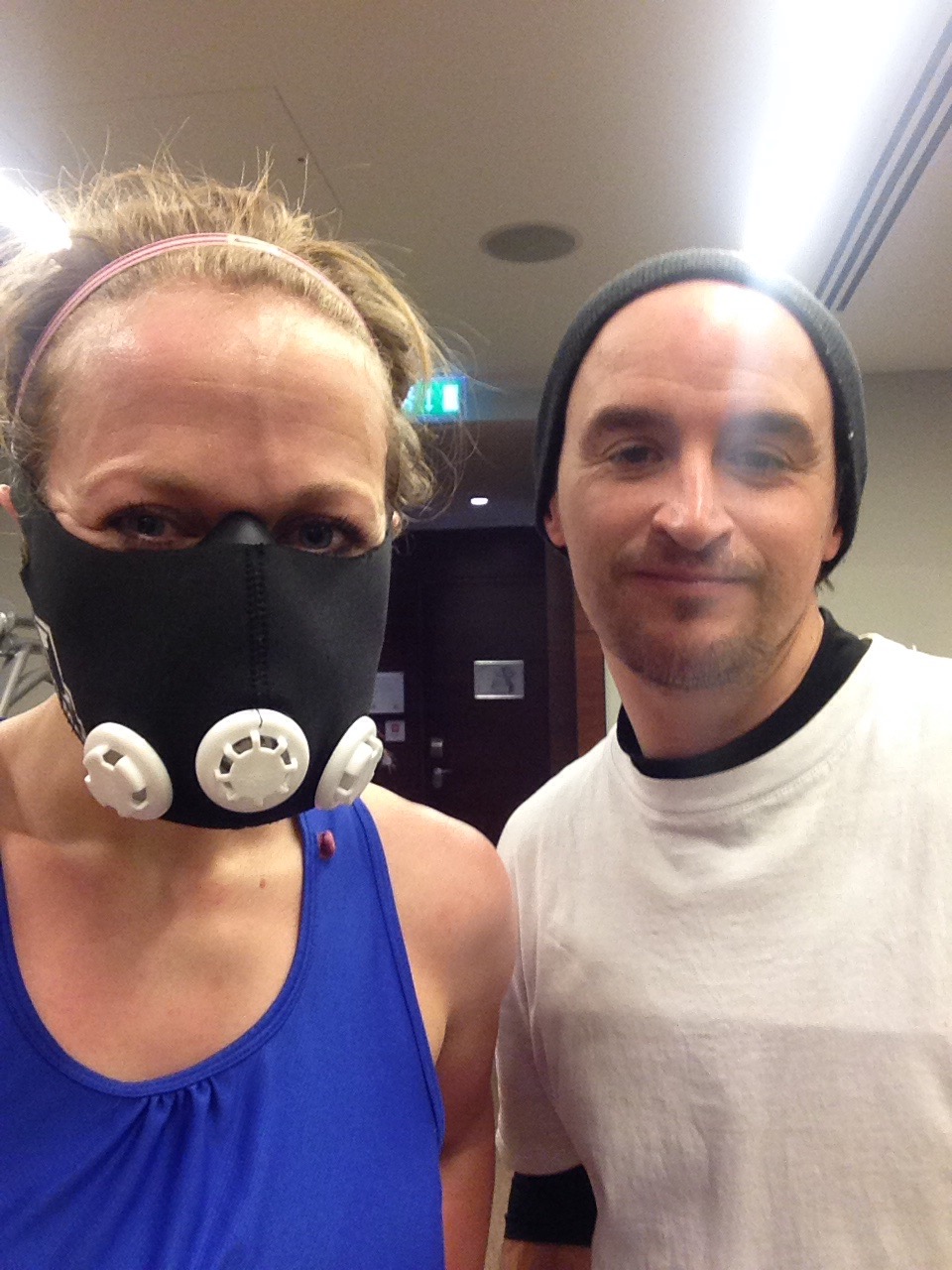
A myriad of things (think building leaks, illness and general work/life balance being the wrong way round) set out to try and prevent it happening, but a few weeks ago I was able to try my hand at the sort of thing that typically happens when you live in say, Colombia or the Rift Valley – hypoxic training…or for those of you who don’t recall this from your sports science degree – reducing the oxygen available to the body. In this case, it’s all down to a clever little mask.  Which makes you look either like Bane or Hannibal. And sound a bit like Darth Vader.

*Disclaimer – the session was provided free of charge, however all opinions are my own*

A nice and leisurely 8am session was a great idea, meaning I didn’t have to leave my flat until 7.20 to get to the gym, WIN.The Conrad St James is super easy to find – bang opposite St James’ tube (although I walked from Victoria, which took about 10 minutes) and very close to Met Police HQ. It is, as you’d expect, a gorgeous location, with the kind of reception staff you would expect from a high standard hotel. (also meaning there are gym towels, lockers, a fridge full of still and sparkling water and the ever-present hotel gym green apple offering!)

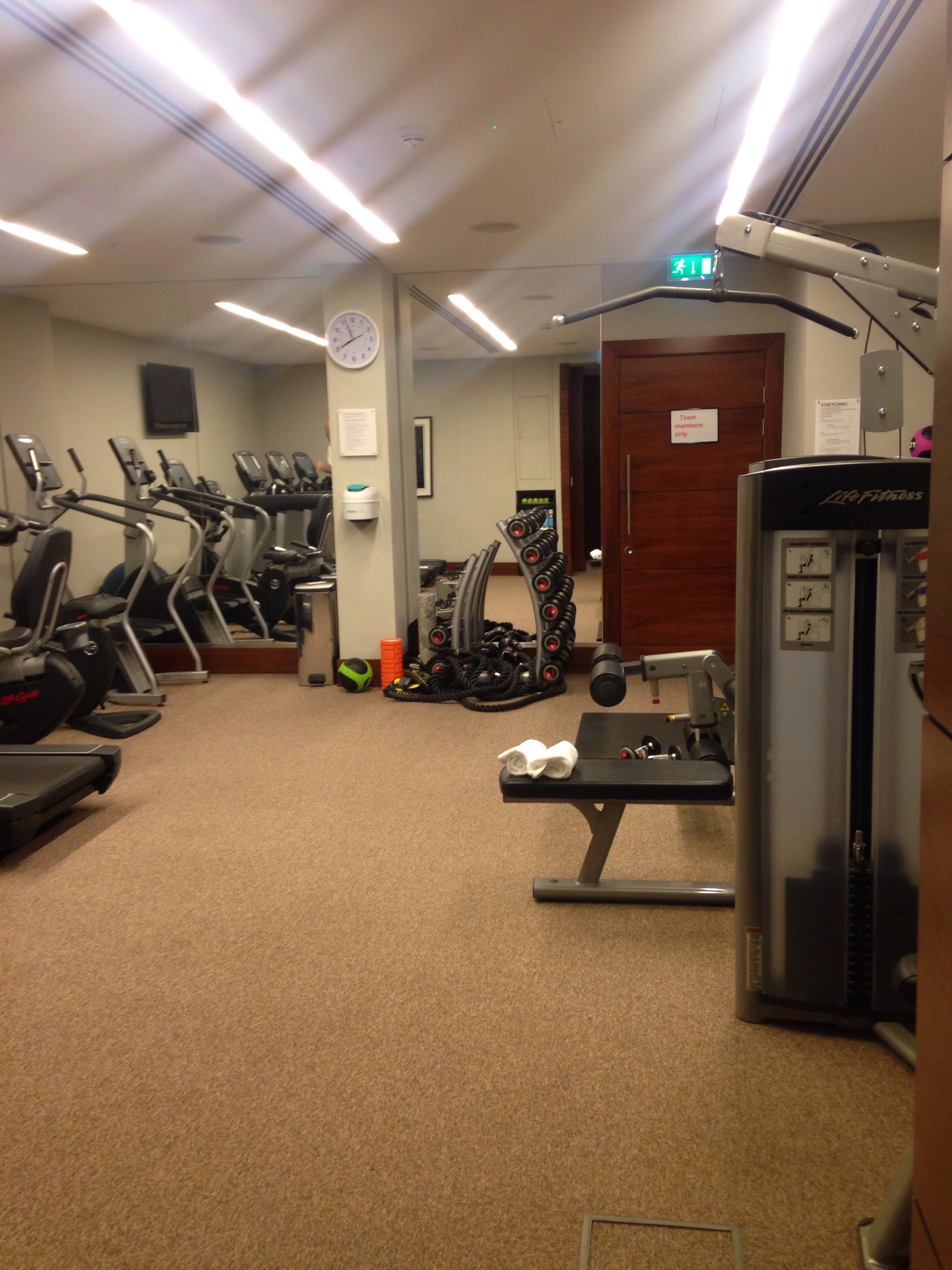
The gym is tucked away downstairs and upon entering, my initial worry was confirmed – it was a typical hotel gym aka about 4 square foot, with a weird “this can do everything” weights bench and your usual limited cardio and weights equipment.Ugh.


However, don’t judge a book by its cover Katie.

I was welcomed in by James and we had a chat about the class, the team, the locations (think luxury hotels in St Tropez and Lisbon….much more appealing destinations than London on a dreary Wednesday morning!) and what was coming. I went along with the naive feeling that, being a fair few months into a marathon training programme, I was in pretty decent shape, but was promised that this would really help to test where I wasn’t in shape. And where I needed to focus.

Circuit 1 went something like this:

Bear crawls, ropes, more ropes, duck walks, boxing, burpees. BURPEES. I hate burpees. However I have a real respect for anyone who puts them in a circuit though as I know they do their job.

Circuit 2 was similar, a few changes in exercise, but of note was that BURPEES were in there again! At this point I was pretty glad I didn’t have the mask on yet, purely because the feeling of burpees couldn’t possibly be made any worse…

However, after this, out came the mask. And yes, I looked like Hannibal. If Hannibal had blonde hair.  I found the biggest challenge was learning not to panic when you couldn’t breathe. It’s like swimming, or anything where you need to focus on your breathing – the more you panic, the harder it is. I have a feeling if you do yoga and are good at controlling your breathing, you will do this a heck of a lot better than me…


The choice is yours whether to wear the mask or not – and I’m not going to lie, it was a pretty tough session even without the mask on! I wonder whether I would have pushed myself more not wearing it – I was struggling so much with getting used to it and worrying that I couldn’t breathe that I probably put less intensity into the exercises themselves (i.e. burpees) I think thought that after a couple of sessions you would easily crack it and begin to reap the benefits. There’s a whole host of studies about the impact of continued oxygen deficiency on the body (it boils down basically to being able to do a better job of transporting and using the oxygen you have available when you limit it) – and this is a legit way to do it rather than a) becoming a pro cyclist and going the short way round or b) spending months living up and training down mountains.

Fail #1 is misplacing my HR monitor. I have no idea where it is (probably under my bed) – and I wish I had had it for this session to see the impact that putting on the mask actually had. Claims are big – up to 1000kcal in a 45 minute session.

Fail #2 is thinking ‘I’m sure I will be fine wearing a mask’. Nope, it’s less fine than you think it will be – it took me a good circuit and a half to feel comfortable wearing it and less like I was going to have a full scale panic attack. But once it’s on and you’ve got used to it – you begin to forget it’s there. Until you realise how much harder it is making things feel!

Fail #3 is doing an arms session the day before. NO! This made my press up ability very limited – and meant my planks suffered as well. I get to the point now where I just think I am in a permanent state of DOMS.

In summary:

  • It’s new, exciting and different
  • You don’t HAVE to wear the mask – you’ll get a decent workout whatever you choose, but it’s a great little thing to try
  • You also won’t be FORCED to wear the mask – I whipped it off a couple of times mid circuit for a few quick breaths and then popped it back on again, it’s amazing what a bit of calm and reassurance can do to you
  • You can do A LOT in a hotel gym with minimal space. This I think is down to great planning and a trainer who knows what gets results – big thumbs up to this approach
  • Always trust a PT who can judge you early on – the best ones can read through the lines and push you to do what you can, rather than what you think you are a bit too tired to do

I then popped to work with a spring in my step – I showered at the office so didn’t get a chance to see if you were able to use any changing facilities – and was buzzing to tell people what it had felt like!

Skinny Rebel workouts run at Conrad London St. James for guests and your regular selves. The workout is priced at £40 for one 45 minute session, with block booking offers available. For more information and to make a reservation, email: info@traindirtylondon.com – or they’re also on Classpass.  The team also offer a range of PT options – visit the website for more information.


10 ways to have the perfect race

Having just come off the back of a PB at the London Marathon, but a slight longing feeling of “I could probably have done that better”, the best thing to do is have booked in another race, right? (For all those coaches out there who are reading this and groaning at me, I promise I won’t complain when I get injured, but this is one of my favourite races so I HAD to do it)

The Pednor 5 is a low key local race on a looped course, originally named “The Pednor Loop”…which just happens to be bang on 5 miles long!  It’s put on by Chiltern Harriers and it’s one as a family we’ve been doing for a good few years now – and it’s always on May Day Bank Holiday, 7pm start.

Seriously, every year I run this race I spend about 90% of the day wishing I hadn’t signed up for it or that it was a 10am, rather than a 7pm, start. And this year was no different – which meant I wasn’t expecting anything great to take place when 7pm finally rolled around…

However, I came out of it with a new 5 mile PB, and a 4th female position – and a smile on my face. AND I WAS HAPPY! At no point had i felt I was really struggling or that I had judged it wrong – the total opposite to mile 20 of the marathon, or indeed mile 1.5 of Tooting parkrun on Saturday…

  • As it’s an evening race, throw all caution to the wind the day before – drink as much cider as you want, practice rugby in the back garden and just generally forget that you have a race the next day

  • Pick a nice distance. 5 miles is fun! It’s less painful than a 5k where I have a tendency to go all out too early on, but it’s not as long as a 10k meaning that you can push to the right degree.ish.
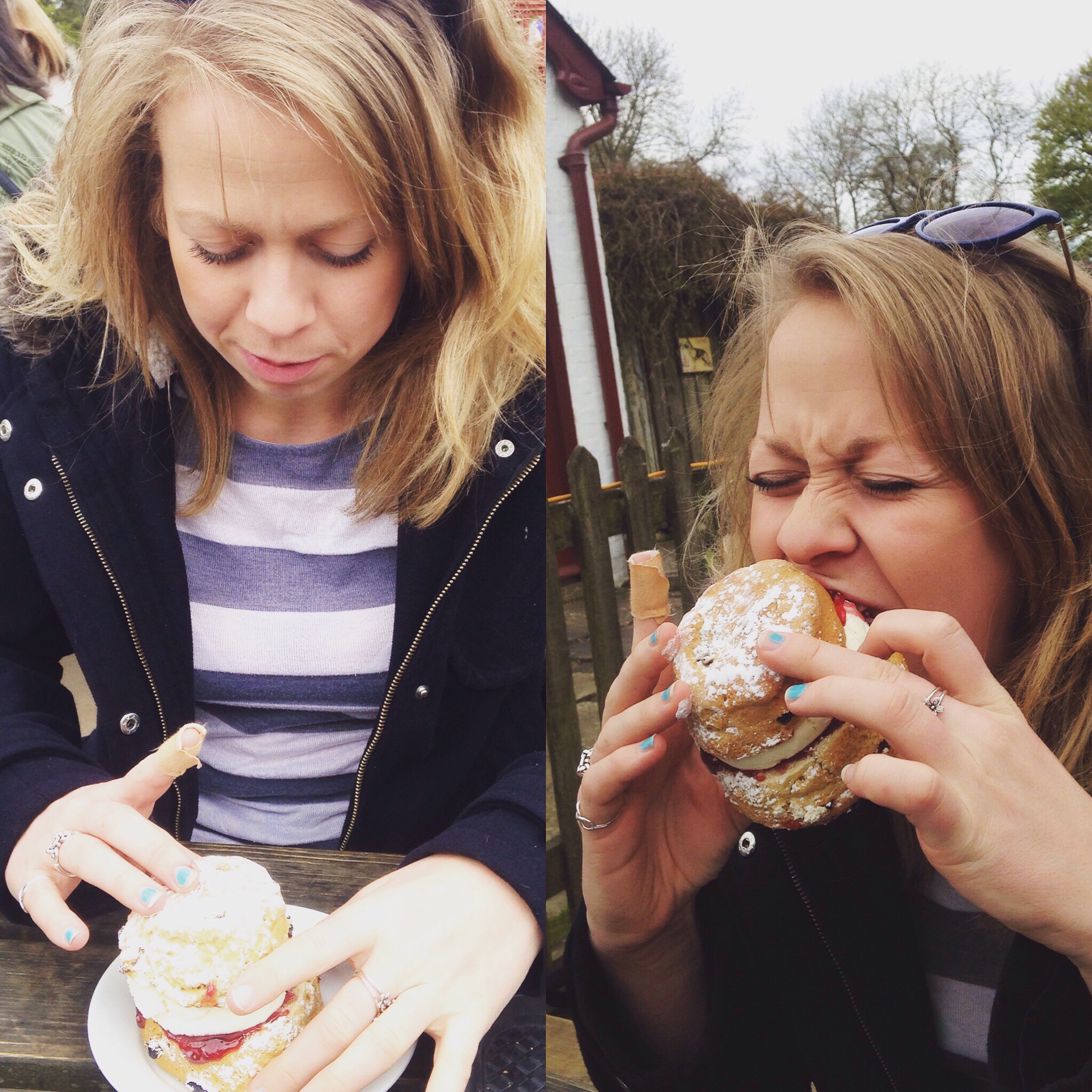
  • Fuel well during the day, including sausage sandwiches and scones the size of your face. And flapjack (remember you are still in marathon recovery phase so can still eat a lot and justify it)

  • Know the course. I’ve run it multiple times and we went out and recce’d it again on the bikes on Sunday because Dave hasn’t done it before. I think the hills actually felt harder on the bike…(actually maybe don’t know the course. My legs felt shattered on the bike the day before and I was already dreading the big hill…)

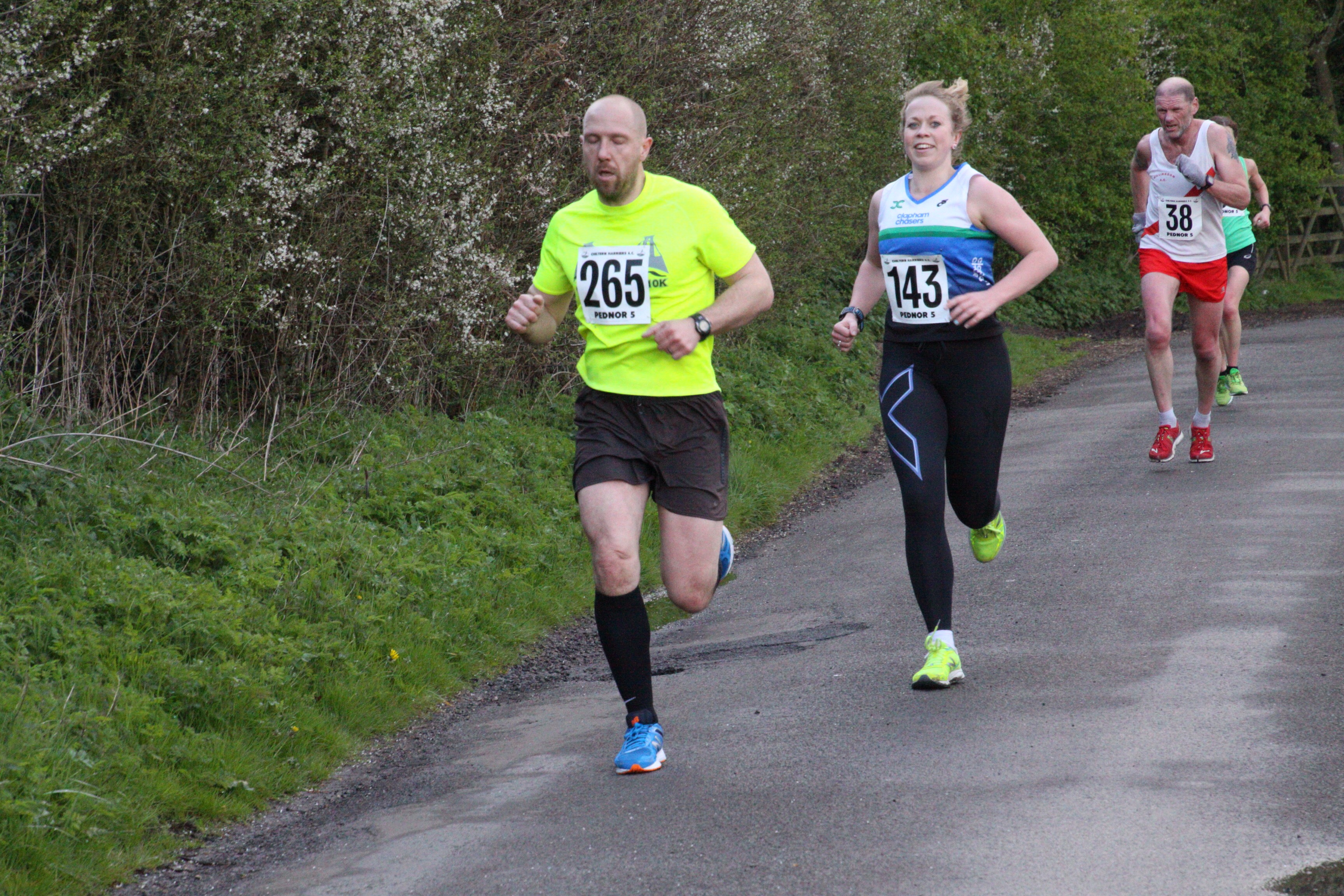
  • Find a race friend. Mine was this man in yellow. We ran together from about 2.5 miles, had a bit of a chat, gave each other some encouragement and generally helped each other stay on track.

  • Trust yourself on the hills. I am RUBBISH at hills currently because I’m not running them very much, but I found myself catching people which gave me a new found confidence. Also helps here knowing the length of the hill (see point earlier) which meant I pushed harder than I probably would normally plod.
  • Make it look like you are finding it easy. This was interesting – most of the people I passed in the first 2 miles sounded like they were about to keel over and die – which made me focus more on my breathing and not sound like them. And it worked!  Secondary to this – smile at cameras!

  • Be the hunter, not the hunted. Pick people off and breeze past them. Put on your best “I’m finding this easy” face as you go past and make people scared of trying to catch you. I was mainly picking out the women – and when I passed the last I could see at mile 4, I made a pact to myself that I wouldn’t let her back past me (so this, + man in yellow, made me have a pretty fast last mile, despite the uphill)
  • Don’t make it your A-race! I was putting minimal pressure on myself for this run and it showed. Have a race you tell everyone about, then have a secret squirrel race that you are secretly going to ace. As a sub-bullet here, pick a course that you don’t expect to do well on. Pednor has a couple of hills, but also some quad-bashing downs.
  • Actually listen to advice about keeping it steady in the first half before then pushing on. Then you will do things like run negative splits, nice mile times and LOADS OF CRs ON STRAVA!!


All race photos by Barry Cornelius – available at http://www.oxonraces.com

VLM 2016 – aka the one where the wheels fell off!

So, it’s that time of year again! The one day of the year where everyone gets inspired, and plans to run a marathon next year. And also the one marathon of the year that most people seem to think is the ONLY MARATHON EVER. And I always get shocked watching the highlights at the amount of people willing to talk to Denise Lewis rather than tell her to naff off because you’re trying to PB (sorry Denise!) So here is my London Marathon review.

I’ve been pretty restless the last few weeks or so – a busy month at work combined with some missed sessions, a niggly Achilles, knee and hamstring (YUP I’m getting the excuses in early here!) has meant my expectations were rapidly rapidly going downhill.But IT’S LONDON AND THEREFORE YOU HAVE TO BE EXCITED!

Anyone who has asked recently about my goal has been told “3.20 – 3.30”. Truth be told, I didn’t even back myself to get that. I’ve never really felt that I’ve ‘got’ how to run a marathon properly. I’ve had people telling me I should have been pushing more towards the 3.15 end of things, but to be quite frank, the thought terrifies me. And if the thought terrifies me, then there is very little likelihood I’m going to get anywhere near it.

My taper was a real taper – and by that I mean I hardly ran at all. Instead, I spent a lot of time acquainting myself with my foam roller, a lacrosse ball and some kinesiology tape (applying this to your own hamstring is quite hard) and hoping for the best…

I got uber excited picking up my number at the expo on Friday evening – the buzz is incredible and it’s such a special event. I think I wrote something imaginative like “I love running” on the wall.

IMG_1334[1]

Managed actually not to purchase anything – wasn’t quite sold on the tshirt this year so no snazzy memorabilia.

Saturday was spent at the rugby before coming home to a pre race dinner of a jacket potato with beans and some chocolate and some ice cream. Dinner of champions!

The usual wake up, get ready activities took place. It was raining when I woke up. (Didn’t really have contingency plans for clothing)

Boyfriend taped up my Achilles and told me it was all going to be OK. I told him I did not believe him, I didn’t want to run and I was going to be rubbish. We then had a ‘fine then I won’t try and be motivational if you’re going to be like that’ type disagreement. (He is learning every time how to get better at this, basically by either ignoring me or agreeing with everything I say) I got on the tube (rain had stopped) and headed to London Bridge, no real wait for a train to Maze Hill and then the usual trudge up the hill to the Green Start whilst eating a bagel with PB.
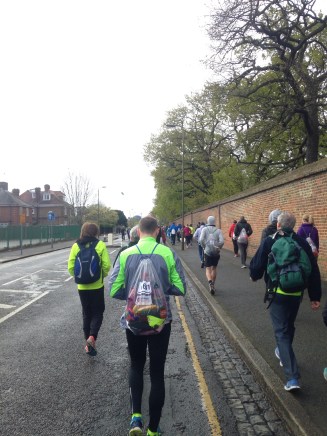
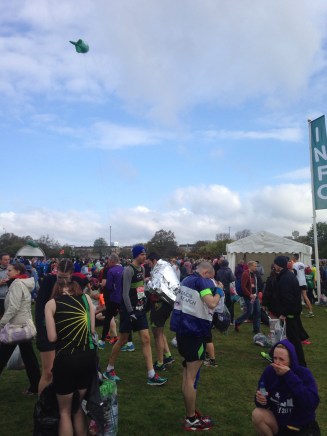
 

This is when you start to realise exactly the scale of the operation – and green is only a handful of people compared to red and blue!  It’s incredible seeing the sheer volume of people heading in one direction.

I took a gamble that I would be OK wearing just a bin bag. Despite the fact the organisers had specifically sent an email saying it would be cold.It was cold. Ended up finding some fellow Chaser ladies huddled in the changing tents.  We had a bit of a chat around times and worked out a few pairs – Cat has a trail marathon next weekend so her and Jas were going to be hitting the 3.40ish mark, and Korkoi is “IM training but not doing as much running as she should be so not really in marathon shape” so we decided to go out together. Plan was hit a 3.25 pace and just see what happened.
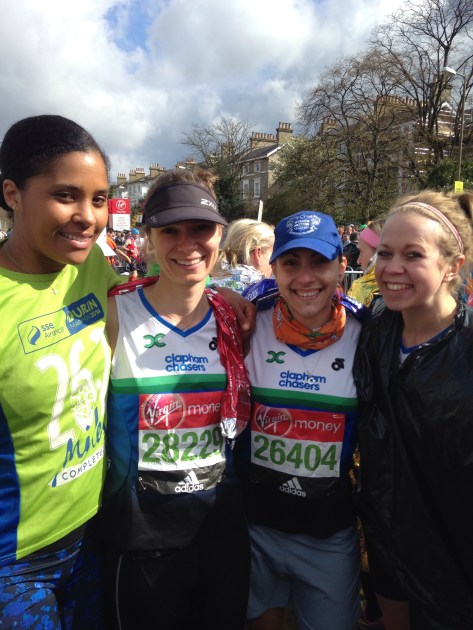

Greenwich was fairly quiet as usual from a supporter side, lots of people warning you about humps in the road, and it felt fairly cluttered with runners as the first 10 miles or so always do! We eventually got caught up by ANOTHER Chaser, Leanne – we had set a fairly similar goal (to be entered into the very very accurate cheer squad spreadsheet tracker) so we decided to push on as a three – and it was great to have a little bunch together, especially all in club vests. There was lots of “Come on Chasers” support all across the course, and this was such a nice little boost. I’ve also realised I quite like not having my name on my vest – this means that anyone who shouts Katie is someone I actually know, which is quite a nice feeling.

Here are some ugly pictures of me running, courtesy of Darren Tanner.

img_1374img_1373

Knee gave a little bit of a niggle around mile 8, which wasn’t ideal…but surprisingly, my Achilles and hamstring felt GLORIOUS (well as much as they could!) At mile 9, my little support crew were ready and waiting. This time, the cow bell had been remembered (we always forget the cowbell for races…) I think I remember thinking at this point that the pace was probably quite optimistic…(we were running solid 7.30-7.40 splits)

We lost Leanne at around 11, but Korkoi & I continued on, over the amazing sight (and sound) that is Tower Bridge with thousands of people either side, before hunkering down on the Highway and spotting the leading men coming the other way (with a fair old gap between them and anyone else) The Chaser cheer brigade were in full force around mile 14, covering both sides of the road, including Ingrid the mascot (inflatable doll…don’t ask) and a few pints in hand.

The gloves were eventually thrown around mile 15, round about the same time I decided I wanted to put my headphones in – I was beginning to feel the strain. Korkoi and I kept pretty close together round the Isle of Dogs, which is always a bit of a drag for me, but spruced up by my support crew being ready and waiting around mile 18, which is roundabout where she started to pull away. Had gel #3 probably around Mile 16. Citrus flavour this time.

I hate Canary Wharf. Some people think the buzz is amazing, but for me, this is where it starts to hurt. I think it’s the slight incline up to the roundabout that does it – my legs just didn’t feel the same afterwards.

I hate Poplar High St. And the drag back to 21 (despite Run Dem Crew being brilliant – we’re taking some tips for the Chaser squad next year!)  Basically my least favourite bit of the London Marathon is mile 20-22. I say this every year. And I don’t learn.

I hate coming back along the Highway. Everything seems so much further away than it normally does. And everyone is so cheery and all I wanted to do was listen to my music and zone out but the crowd were too loud. (I think you get where I’m going with this – I had a pretty bad time over the last 10k. There was a tiny bit of walking – the ‘having a drink’ technique – but everything was starting to feel the force of the fast 20)

(I’ve been having a discussion with a guy at work about this – my love for the crowd was waning at this point. I don’t want to sound like a brat, or ungrateful, but seriously, if you’re in a bad place, the crowd are actually incredibly frustrating. I wanted to zone out and listen to my music – but I couldn’t hear it. I wanted to slow down – but they kept shouting at me. I wanted to not be experiencing some severe pain surrounded by 000s of people. I wanted to cry. Maybe in a way this is good, because it stopped a lot of these things – but at the time, all I could think was JUST GO AWAY. Especially anyone who says “you’re nearly there” at mile 20. THAT IS A LIE)

Stole Haribo from a small child (same as last year) but didn’t have another gel – and looking back, I wish I had,  because it was just sitting in my belt… Saw my friend Hannah at Old Billingsgate and then mildly perked up going into the tunnel because I knew that once I was through that and up the slight (MASSIVE) incline under Blackfriars Bridge, it was simply a case of the longest two miles in the world. Apparently I missed Colin Jackson here but ain’t nobody got time for that, I’ve got a PB to hit!

When I realised the wheels were falling off (i.e., mile 20) , I was doing lots of mental calculations. “It’s OK, I can still get under 3.30, I just have to run 5 x 9 minute miles” and so on. Switching from 9 minute miles to 5 minute km to 8.30 minute miles to 6 minute kms. Round and round and round.  I think this kept my brain busy. And everyone I notched around the 8.30 pace, the more I realised the goal was back in sight. At mile 24, the clock said bang on 3.10. That meant 2 x 10 minute miles, plus the little bit extra, minus the little bit I had in hand from getting over the start line and I WOULD BE THERE. Simply a case of gritting teeth and hanging on in there – I wasn’t having this pain for nothing.


My family said they knew I was struggling/had tried harder than last year because I looked a lot less happy (see above photos). I nearly missed them on Embankment, but luckily fishwife mother was on form with her shouting. My stride was off, I was just plodding. But plodding at a just about OK speed to get me there. The Houses of Parliament actually came up sooner than I was expecting them to – considering I run this route on a regular basis, I think I just switched off.

Running up Birdcage Walk, I had THE WORST wave of nausea ever. I mean I have never come that close to throwing up from running, but somehow managed to convince myself if I was going to vom, I wasn’t going to do it until I had crossed the line. I also had a really self-conscious thought of not wanting to go to the side and accidentally vom on a spectator’s foot or something. I got overtaken here by a Roman Soldier. And then by Elvis as we rounded the corner – and then suddenly the finish line was in sight! And it was saying 3.28! I had no idea about what my time over the line was, but knew I had done it as long as I could shift my backside down that last straight within a minute. And I have never felt so happy to do so.

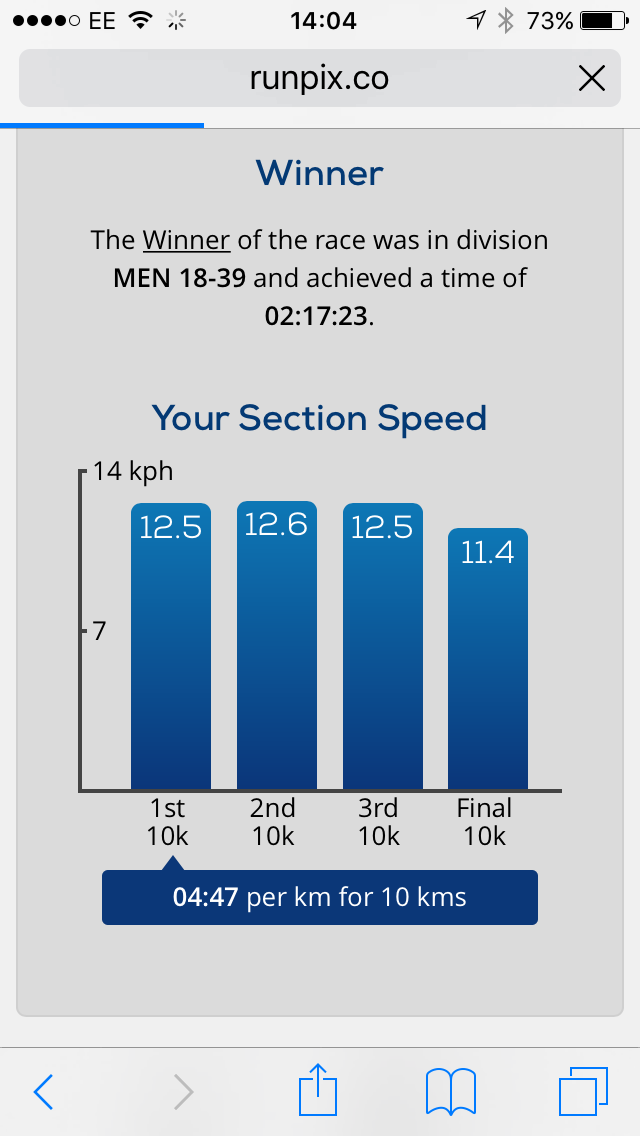
3.27.32. A new PB, 817th female and 524th AG. 6 minutes off last year.

I didn’t really know what to do when I had finished. Whether to cry, to be happy, to stop, to walk. It’s a weird feeling, finishing a marathon – fairly overwhelming. I was also overwhelmed by the amount of support I had when I checked my phone – from people tracking, to congratulating – it really made it worthwhile.

Bit of post-race analysis..

  • My splits were horrible I mean truly, this was a beautiful example of ‘pushing hard early on and it catching up with you’. I was probably on for a low 3.20 until mile 20, and then I dropped straight from 7.38s down to 8.20s. And there was nothing I could do about it!
  • However, I am 99% sure it would have caught up with me even if I was slower – so was the banking time strategy a success? Who knows?
  • I am also very happy about how evenly I ran the first ¾ of the race. I truly wouldn’t have done this without Korkoi & Leanne to push me through it. And to be quite honest, it felt comfortable until then.
  • Here is a PERFECT example of ‘a marathon is a 20 mile run with a 10k race at the end’  done badly, or ‘here is a wall, do you want to run into it?’

Look out for a future post entitled “What I learn most years when I run a marathon and really should remember for the next training cycle rather than saying at the start I’m going to do it and then not doing it at all”

(Well done for reading this far!)
Paying for parkrun?

Unless you live under a rock, or have absolutely zero interest in running, health or fitness (in which case, I’m impressed you are reading this!), you’ll know the big ticket news item this week has been the decision of Stoke Gifford Parish Council to levy a charge for the use of the park for parkrun.

People use parkrun for different reasons. I for one have never needed parkrun as a motivator to get me out of the door and go for a run, but it has helped countless other people do just that, without having any barriers around gym fees or paying to use facilities. And surely that’s what we need to continue to do?

There was a decision recently that the NHS would be funding overweight and diabetic patients to receive PT sessions and nutritional advice free of charge – surely the need for this can only go up and up if we start to put BACK the barriers to exercise such as cost, location and the intimidation of entering an unknown world that parkrun have worked so hard to bring down.

Thing is, you take any paid for 5k race – the standard is bound to be much higher as people who are more committed to running are more willing to pay. So, if you do take that jump into a more traditional 5k race and you are that bit slower or less experienced, where does that leave you? Feeling chided for being at the back or demotivated for being slow? The beauty of parkrun is that it’s open to everyone – the annoying people like me who are there mainly so that can keep banging on the door of 20 minutes, right the way through to someone who is walking it with their friends because it gives them an organised time and place that they can’t back out of. If you are lacking confidence or need that regular weekly slot to get you motivated to get out the door, how likely are you to search out a 5k race, pay a fee and turn up – especially if you aren’t even sure if running is for you! Entering a ‘race’ sounds intimidating – whereas a run is much more open.

But when you can get to something free and local, come rain or shine, where you have an incredibly friendly reception (I mean come on, when was the last time you were clapped and heartily welcomed for it being your first time going to the gym, or visiting a pool that wasn’t your local), plenty of knowledgable people on hand for any questions AND an incredibly straightforward way of being able to see your improvement – why would you want anything else?

Counter argument state that sports clubs and personal trainers have to pay for use of the park, so why shouldn’t parkrun for runners? Where does the line stop where I have to start paying every time I dare to run around Clapham Common, let alone when we have it on our regular running club routes? I recently posted about the true cost of running, and one of the best things is that it can be done anytime, anywhere, without having to pay entrance fees. Yes, organisations like BMF are levied with hefty charges for park usage, but have you seen the prices of their classes? Same with football clubs – yes there are some membership fees, but there are goalposts to maintain and white lines to paint. I pay to be a member of a running club, but so many people would never consider themselves able to join a running club. parkrun means they don’t have to.

Parkrun was set up as a not for profit organisation designed to help reverse the current trend of inactivity that is sweeping our country. It’s spiralling and growing in so many countries around the world – my uncle was delighted when the first Parisian parkrun was launched earlier this year, having attended several events whenever he is in the UK. There are countless people taking to social media to talk about how parkrun was the trigger to change their inactivity and improve their health. Yes, parkrun has some paid employees and yes, they do attract sponsors, but that is all funneled back into running the events we know and love.

The decision is that parkrun should have to contribute to funding (rather than the initial £1 per runner), however, if other councils started to take this on board, there would be no other choice than to start charging runners to participate, because how else would they be able to raise sufficient money to fund over 850 events? The beauty of parkrun is its diversity and accessibility. Without it, there would be hundreds of people whose usual activity on a Saturday morning is lying in bed…and so far, there are over two million registered runners who have started to buck the trend.

Apparently it’s unfair for non-running residents to have to pay to cover upkeep of the paths. If you continued in that matter with regards to any sort of tax or public funding, it’s ridiculous. Do we then stop any ‘non-runner’ from using the path because it was funded by runners? Do parks then stop becoming public? I haven’t been to the doctors this year but I’m still paying for it because it’s there when I need it (lighting the touchpaper here!)

Obviously yes, some areas will take more wear and tear (e.g. anything run on grass in the mud can get a bit battered), but there was probably a more strategic way to go about asking for support. If the other councils can cope, why is this one so different? At Tring, there was support from the local council to get things set up, and the Woodland Trust contributed to kilometre markers- and both organisations continue to do so. The council decided it was a worthy cause for a grant – so why don’t others think the same?

You take away parkrun and you take away support for the local community – local cafes get an influx of people at 10am on a Saturday morning, and plenty of councils gain a little bit extra from parking charges.  It’s great to see support from some high profile athletes and government support – but it’s a story I will be keeping a close eye on.

So, tomorrow’s Little Stoke parkrun has been cancelled, however I have a feeling it won’t stop people rallying for support. So I urge you to get down to your local run tomorrow and just appreciate what it is there for – even if you’ve never run before. It takes 5 minutes to register and print out a barcode. Take some time to appreciate what the volunteers do week in week out. Take some time about the benefit it brings to the community and all those whose journey to health started with parkrun.

Pubic hair. Yes, you read that correctly.

I know this isn’t strictly to do with sport, but given the only time I really come into contact with this as a subject is in the changing rooms at the gym or swimming pool, I’m lumping it in under the women’s sport umbrella. The subject being: pubes.

That’s right people, roll up, roll up, I wanna have a conversation about our bushes. Our beavers. Our foofs. Our lady gardens. The grass on our wickets. Our fuzzy landing strips. Our carpets (whether they match the curtains, or otherwise). Our untamed shrews. Our shaven havens. Our vajazzles.

The other day I read an article extolling the virtues of something called ‘Bush Oil‘, a British-made mix of essential oils designed to make pubic hair smoother, shinier and healthier. ‘Delightful!’ I hear you cry, ‘what has that got to do with anything?’ Well, seeing as you ask, it goes some way to evidence the fact that many of us are turning our backs on the painfully trendy fad of waxing off most, if not all, of our pubic hair. In fact, I would go so far as to say, the bush is back. Hooray!

I’m not sure whether this is weird or not (you can be the judge) but the only time I really give a monkeys about the state of my wax (or lack thereof) is not in the bedroom – frankly, if you have enough time to worry about it during the throws of passion, you’re probably doing it wrong – rather, it’s in the shower after the gym, swimming or playing sport, when the only people who’ll see are other women.

Kim Kardashian once proclaimed that women shouldn’t have hair anywhere but their heads, and Victoria Beckham suggested we should all be made to have our first Brazilian waxes at 15. As if we don’t give each other a hard enough time as it is! We judge each other on so many other beauty standards – how clear our skin is, how much make-up we wear, whether we are too fat or too thin – do we have to eyeball each other’s nether regions and pass judgement too? Is nothing sacred!? And why is it that women believe they should be bare down there in the first place? A number of things, but primary amongst them, porn. There’s a school of thought which theorises visual pornographers actively seek to infantilise women, but on a simpler level, pubic hair is a no-no in the porn world because it gets in the way of a clear shot of the action.

That’s all well and good, but porn movies don’t ever show the realities of the potential side effects of shaving or waxing the old lady garden – or at least I don’t think they do; there’s probably a whole sub-Reddit devoted to the ingrowing hairs, infections and razor rash that I haven’t stumbled across yet. In fact there’s loads of benefits to sporting a bit of fuzz down there; not least of which is that is saves you the time, pain and money it takes to get it waxed.

To summarise, my boyfriend is happy so long as things are trimmed and tidy down there (which makes practical sense to me anyway – spilling out of ones bikini bottoms isn’t a feminist statement, and it will get your Instagram account deleted… that’s a story for another day though), but I am judged by my fellow woman in the gym showers because my pubic region looks too womanly and I’m not in a state of perpetual readiness for filming an adult flick? Great.


10 tips for a confidence boosting run

Feeling a bit meh about your progress? I have been recently, especially on the long run front. However – today was a different story, and I think there are a few things that contributed to it.

I realised today that the 24th April really isn’t that far away. 4 weeks on Sunday aka 30 days. And, as off this morning, I hadn’t really had any solid long runs. A crappy 19 and a supposed 19 that was actually a 17 because I got the bus back from Earlsfield because I was just fed up (LOL the benefits of living in London!) There have probably been some OK 15-16s, but nothing really to write home about.

On the plus side, my speed is still sticking around – I had a pretty decent run at the SEAA relays last week at Gravesend, clocking a 6.17 average and hopping my team up a place, which I was quite happy to have done on leg 5, but it was only just shy of 3 miles…nothing major to write home about when you are supposed to be marathon training.

However, back to today – 19.5 miles and I enjoyed pretty much every minute of it. I might not be quite where I want to be as life has VERY much got in the way of training, but today was a perfect mental boost that everything little thing is gonna be alright (singing some Bob Marley here)

So read on for a few tips to help you get your head back in the game, fall in love with running again and, most importantly (well at least for me right now), help you realise that you can achieve your goals…

  1. Enlist company

My mum had her final long run before Manchester on the plan for today. So we started out together and did the first 5 as a team, before I started to play. My dad also kept popping up on his bike and then we all went for breakfast after. There’s something about taking a chunk of a long run up with other people that makes it SO much more bearable. It distracts you and allows you to relax a bit. Running can be a lonely sport – and the more time you spend with your own thoughts, the more time you put an internal pressure on yourself.

  1. Take a route away from your usual.

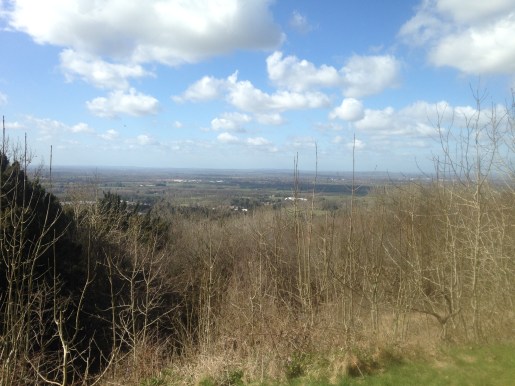
Switch it up! It’s BORING doing the same thing day in day out. I’ve got used to the same routes and it’s making things stale. It was so nice to be doing my long run out of London. I mean, Richmond Park and the Thames path are lovely as far as London goes, but just getting there stresses me out – traffic, people, too much crossing of roads. I was back in the country lanes, with great scenery and the odd hill here and there. Mentally, this allowed me to switch off a bit more and it seemed like less of a chore. Plus I got views like this:

IMG_0996

  1. Do something a bit different.

I changed it up. I knew I wanted to do around 20 miles. I didn’t know what pace, or if I was doing a few at planned marathon pace in the middle. So instead, I did 5 easy with mum, then proceeded to do 1 around 10-15s faster than PMP (so around 7.35ish), then turn back round and go and find her again and do a slow mile. So this times 5. Which took me to 15. And then really, I didn’t have that many miles left to go! I got to 15 without feeling like I had got to 15, and my focus was a mile at a time rather than the whole 20. Yes, a training plan is generally needed, but it’s not the script of life. One deviation won’t ruin your race.

IMG_1019

  1. Have a vague, not an exact plan

My mum had planned a route, I hadn’t. All I knew was where I needed to be for breakfast. My choice to do on/off miles 100% was not in the plan. It started really so that I could keep running with her but then I kept it going. Then I changed my route in my head. And it all worked out OK.Not worrying about the exact second you have to meet per mile takes a heck of a lot off your mind. I mean the downside is, you end up 10 miles from your front door, so do make sure you check a map.

  1. Don’t be afraid to take a step back.

Around mile 18 I cut into a footpath and there was a fiddly gate. I took a minute or after going through so to regroup and you know what…the world didn’t collapse around me. If you need to walk, stop, breathe, drink, take a week off, take a month off, then do it. It is 100% OK.

  1. Take the pressure off

I didn’t really think about what I was doing today. There was no “I must run at this pace for this long” And you know what…I ran exactly what I needed to! I ran more by feel than looking at my watch and it was a pleasant surprise. I did far better than I was expecting myself to. So throw caution to the wind, leave the garmin at home, turn the screen to be under your wrist, set yourself certain points to check it – running isn’t all about a numbers game, and you may be shocked by what you can do when you aren’t forcing yourself to do it.

  1. Don’t panic.

During the faster one miles, I felt like I was out of my depth. Which is ridiculous, I know I can easily hold that pace for a mile. A bit of internal chit chat and a smoother pace helped me get to it. Panicking and trying to push my pace to make up for it just made me out of breath and even more stressed. Same with hills. Embrace them, don’t chase them.

  1. Pick a nice day.

Unfortunately, not always possible, but today it definitely helped. Spending most of the week slogging away in the cold and when it’s always dark isn’t the most inspiring. Good Friday and a day off couldn’t come at a better time. If the sun is out, drag yourself out – you’ll feel better for it.

IMG_0994

  1. Give yourself time.

Again, one that isn’t always possible, but going for a run when there is no pressure to be back is perfect. You aren’t rushing, therefore your time and distance doesn’t matter. And you’ve got time to stretch, relax and wind down at the end of the run. I HATE constantly checking my watch to make sure I’m going to be back in time to get ready for work. You lose the sense of freedom which is so integral to running.

  1. Set yourself a fun activity at the end

We went for a family breakfast at our favourite post run cafe. I knew I had something to look forward to and that helped me take my mind off it. It also meant I knew where I was ending up – so I knew exactly how much longer I had to push for. Visualise the end and it makes it a heck of a lot easier to imagine yourself there.

  1. Remember why you run

Simple as. You wouldn’t be a runner if you didn’t enjoy it in some way shape or form. People fall in and out of love with running on a regular basis and there is a simple way to Make a run happen in the way that helps you reconnect with the reason you love running. This is different for different people – it might be hitting fast 400s, it might be reaching the top of a tough climb, it might be simply feeling the breeze in your hair. You do you. It’s the best way to bring you back to your senses. Take your watch off. Throw caution to the wind. If you need to take a few days off, do it. If you need a few weeks off, do it. Do what it takes to get your head back in the game – running is a one person activity and you’re in charge.

So, anything else? How do you get out of a rut? Any particular workouts that you know will make you feel on top of things?